







The exception processing message 0xc0000005 unexpected parameters does not identify one universal fault. Record the complete dialog, the program open at that moment, and the action that triggered it. If one application fails, protect its local data before reinstalling it. If unrelated programs crash, broaden the investigation to Windows components, storage, memory, and security software.
Keep the first screenshot and written timeline throughout the diagnosis.
exception processing message 0xc0000005 unexpected parameters: safe diagnosis
Take a screenshot of the entire message. Do not crop out the title bar, executable name, parameter values, or surrounding application. Note whether it appeared at sign-in, shutdown, application launch, file open, printing, saving, or after waking the PC. These details are often more useful than the code itself.
Error 0xc0000005 commonly describes an access violation, but many different failures can lead to that condition. A damaged application module, incompatible shell extension, faulty add-in, security hook, unstable memory, or corrupted Windows component can be involved. The code alone cannot prove which one.
Build a short trigger record
- Write down the executable or application named in the dialog.
- Record the last successful use and the first failed use.
- List software, driver, update, or security changes made in between.
- Repeat the exact action once, but do not create a crash loop.
- Check whether another file or another user account changes the result.
A repeatable trigger provides a test for every later change. If the error occurs only with one workbook, image, archive, or project, the data file may be part of the problem. When every file fails in one application, the installation or its profile deserves more attention.
Preserve Application Data Before Reinstalling Anything
Many Windows applications store unsynced work outside Documents. Profiles, presets, catalogs, save games, mail stores, databases, templates, and project caches may live under AppData or ProgramData. An uninstall option that removes user settings can erase the only local copy.
Use the application’s documented export or backup function when it still opens. Otherwise, identify its data folders from official documentation or the vendor’s support channel. Copy those folders to a healthy external drive without deleting the source. Open exported files or inspect the backup before trusting it.
If the error began while writing a file, preserve both the original and any temporary copy. Do not repeatedly save over the same document. A crash during replacement can leave an empty or partial file under the familiar name while a usable temporary version remains elsewhere.
Related Drecov references cover applications that cannot start, recovery options for corrupted files, and the wider diagnosis of a computer that keeps crashing.
Isolate the Triggering App, Add-in, or Startup Component
Start with the narrowest repair. Update the affected application through its official installer or store. Disable its optional add-ins from inside the program if possible. Test a new blank file and a known-good existing file. This comparison separates damaged content from a broken application environment.
If the message appears during sign-in or across several programs, perform a clean boot. Microsoft describes a clean boot as starting Windows with only essential drivers and startup programs so software conflicts can be isolated. Follow the official clean boot procedure and keep track of every disabled group.
Treat clean boot as a comparison, not a permanent fix
Reproduce the original trigger in the clean state. If the message disappears, re-enable services and startup items in groups until it returns. Then reduce the successful group further. Update, repair, or remove the specific conflicting component instead of leaving normal protection and required services disabled.
If the error remains during a clean boot, the result does not prove Windows is corrupt. It only makes ordinary third-party startup interference less likely. Continue with application repair, a new user-profile test, and system evidence.
A new local user profile is another controlled comparison when the affected application stores per-user settings. Test the original trigger without moving all data into that profile. If the error disappears, export settings carefully or rebuild only the damaged application profile. Do not delete the old Windows account until its Desktop, Documents, browser data, mail stores, and application folders have been backed up and verified.
⚠ Warning: Install it on a drive different from the one where your data was lost to prevent overwriting.
Check Windows Integrity, Storage, and Memory in Order
Open Reliability Monitor and locate the failure at the recorded time. The faulting application and module can indicate whether one executable, a shared runtime, or a driver participates. Event Viewer may add details, but do not delete logs before the pattern is understood.
This check is especially useful for exception processing message 0xc0000005 unexpected parameters. Run Windows Security or another trusted installed security product when malware is plausible. Avoid downloading several scanners from advertisements. A detected threat changes the response: disconnect sensitive accounts, follow the security product’s remediation guidance, and verify files before returning the PC to normal use.
Use system-file repair only for supporting evidence
DISM and System File Checker can repair supported Windows components. They do not repair application databases or personal documents. Record their final messages. If SFC cannot start or cannot fix files, address that specific servicing problem rather than repeating the command indefinitely.
Storage health moves higher in the list when files disappear, saves fail, the system freezes during reads, or the drive reports errors. Recover important data before CHKDSK because CHKDSK modifies file-system structures. A disk that disconnects, clicks, or develops severe read errors should be imaged or handled professionally.
Memory testing becomes relevant when unrelated applications fail with changing modules or the PC crashes under load. Reseat removable memory only if you are comfortable servicing the device and warranty conditions allow it. Restore default overclocking settings before drawing conclusions from a test.
Recover Files Lost During Repeated Crashes with Drecov
PandaOffice Drecov is Windows data recovery software for local files lost through deletion, interrupted saving, formatting, or logical storage trouble. Supported sources include PCs, internal disks, external drives, USB devices, SD cards, and memory cards. In read-only recovery mode, it can look for application documents, photos, video, audio, email data, and archives. Quick Scan, Deep Scan, filtering, preview, and recovery to a separate healthy destination support a crash-related loss. Lost Partition Recovery applies when a former partition vanished. Drecov cannot fix the application exception, remove malware, repair RAM, or restore overwritten data with certainty.
⚠ Warning: Install it on a drive different from the one where your data was lost to prevent overwriting.
Step 1: Open Drecov and Select the Original App-Data Location
Stop saving to the affected volume. Prepare another healthy drive and do not install Drecov on the partition that held the missing files. Open Drecov, then select the original project, profile, document, or application-data volume. If Windows no longer shows the former partition, use Lost Partition Recovery.

Step 2: Run Quick Scan and Search for the Missing Work
Begin with Quick Scan. Browse the former project and profile paths. Search by filename and extension, then compare dates and sizes. Look for temporary or autosaved versions created near the first crash rather than selecting only the newest name.

Step 3: Use Deep Scan Only While the Source Remains Stable
Run Deep Scan if Quick Scan misses the required data and the device remains stable. Stop when the drive disconnects, clicks, overheats, or produces repeated read errors. An unstable disk needs imaging or specialist handling instead of another direct pass.
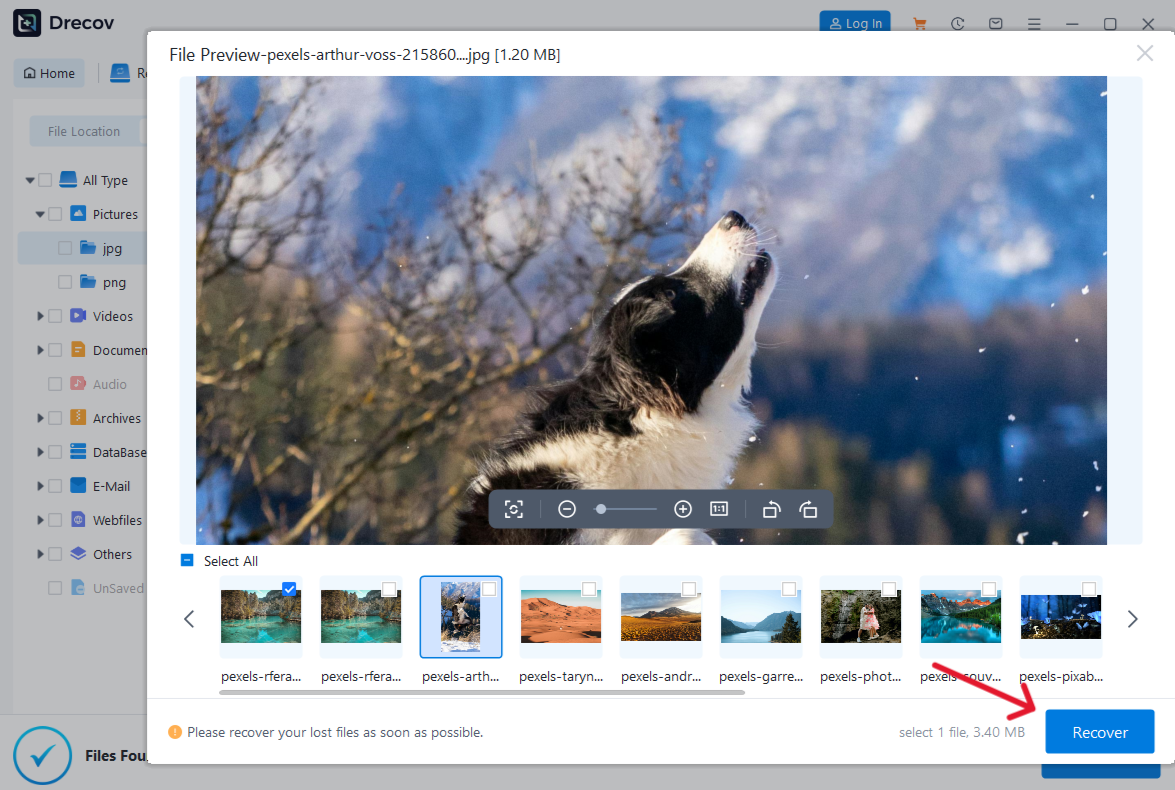
Step 4: Filter and Preview More Than One Candidate
Filter by former path, file type, filename, size, and date where those details survive. Preview representative supported documents or media. A valid preview supports that sample, but it cannot certify every worksheet, archive member, database record, or linked project asset.
Step 5: Recover Elsewhere and Verify Before Repair
Restore selected files to the prepared healthy drive, never to the source. Check the Drecov Folder or Recovery Folder if output is not where expected. Open copies in a safe application context and compare them with backups. Only then should you run file-system repair, reinstall the application, reset Windows, or format storage.
Prove the Fix with the Original Trigger
Return to the exact action recorded at the beginning. Open the same type of file, launch the same component, or reproduce the sign-in sequence. Repeat the test after a restart. A changed dialog is not success if the intended work still cannot be completed.
If one application now works, inspect its logs and update channel before re-enabling optional add-ins. When a clean boot isolated a conflict, enable required services carefully and confirm that security protection is active. Keep the preserved application data until normal operation and a fresh backup are established.
If unrelated programs continue to fail, do not cycle through random DLL downloads or registry cleaners. Escalate using the evidence already collected: faulting modules, memory-test results, storage health, SFC or DISM outcomes, and crash timing. A repair technician or administrator can act faster with that record than with the code alone.
Conclusion
Exception processing message 0xc0000005 unexpected parameters is a symptom, not a complete diagnosis. Capture the named process and repeatable trigger, then protect its local data. Isolate application, startup, Windows, storage, and memory causes in that order. If crashes caused stable local files to disappear, Drecov can scan their original location, preview likely versions, and recover them to another healthy drive. Verify recovered work before reinstalling applications or making broader Windows changes.
⚠ Warning: Install it on a drive different from the one where your data was lost to prevent overwriting.





