







When an app says the audio file format is unsupported, preserve the original before converting or renaming it. The player may lack the required codec. The extension may be wrong, or the file may be incomplete. Test the same copy in a trusted second player and inspect its real media information. If every decoder fails at the same point, investigate damage rather than compatibility.
The audio file format is unsupported: safe diagnosis
Record the application, device, and exact action. A file that fails in a messaging app may exceed that service’s accepted formats. The same file failing in Windows Media Player may require a codec. A recording that stops at the same timestamp in every player may have an incomplete stream.
Ask where the file came from. Camera, phone, voice recorder, web download, editing export, and screen-capture tools can use different containers and codecs. Also note whether the item was copied from removable media, downloaded incompletely, renamed, or recovered after deletion. That history narrows the likely failure.
Run a three-result playback comparison
- Plays fully in another trusted player: the first app lacks support or has a local configuration problem.
- Starts everywhere but stops at one point: the media stream may be truncated or corrupted.
- Fails everywhere and reports zero duration: verify the file size and whether recording or transfer completed.
- Shows zero bytes: no audio payload exists in that copy; look for another original or backup.
Use a duplicate for experiments. Keep the only original unchanged, especially when it came from a recorder or memory card. Conversion, repair, tagging, and editing tools can rewrite the container even when they appear to perform a simple check.
An Extension Does Not Prove the Audio Format
A filename extension is a label. It often identifies the container, but it does not guarantee what streams are inside. M4A commonly carries AAC or Apple Lossless audio. WAV can hold uncompressed PCM or several compressed formats. OGG is a container that may carry Vorbis, Opus, or another stream.
Changing a suffix from .m4a to .mp3 does not transcode the audio. It only changes the label. Some software may then choose the wrong parser, producing a different error without fixing anything. Restore the original extension if you know it, and use a media-information tool to inspect the detected container and codec.
Check the reported duration, channel count, sample rate, bit rate, and codec name. Missing or nonsensical values can indicate an incomplete header. Normal metadata does not guarantee that every audio frame is present, but it helps distinguish a mislabeled file from a completely unreadable one.
Also separate format support from access controls. A purchased or subscription audio file may depend on account authorization or digital rights management. Copying it to another PC can produce an unsupported or unauthorized message even when its bytes are intact. Sign in through the legitimate provider and check its offline-use rules. Do not run repair software against protected media merely because another player refuses it.
For format background, review the Drecov explanation of OGG audio. If a recording was deleted, follow the guide to recover audio files. A media file that opens but sounds wrong may need a separate media-integrity assessment.
Resolve a Codec or Player Problem Without Random Codec Packs
Microsoft explains that a codec is required to decode compressed media and warns that incompatible codec packs can cause playback problems. Its official Windows codec FAQ recommends obtaining components from trusted sources. Avoid large anonymous packs that install many filters you do not need.
Update the target application from its official source. Then test the file again. If the app identifies a missing codec by name, use an official extension or the codec developer’s documented package. Restart the application after installation so it can load the new component.
When the target is a phone, car, browser, or editor
A file can be valid yet unsupported by the destination device. Vehicle systems and older hardware often accept a narrow combination such as MP3 audio inside a particular sample-rate range. Browsers depend on both container and codec support. Editing software may import formats that a simple player cannot, or the reverse.
Read the destination’s documented requirements. Do not assume that “supports MP4” also means every audio codec inside an MP4-family container works. Match the codec, channel layout, sample rate, and bit depth when those limits are specified.
⚠ Warning: Install it on a drive different from the one where your data was lost to prevent overwriting.
Convert a Verified Working Copy, Not the Only Original
Conversion is appropriate when a trusted player can decode the complete track but the intended destination cannot. Duplicate the source first. Choose a widely supported output such as MP3 for general playback, AAC/M4A for many modern devices, or WAV when an uncompressed editing intermediate is required.
This check is especially useful for the audio file format is unsupported. Lossy-to-lossy conversion does not improve quality. Transcoding a low-bit-rate MP3 to a higher-bit-rate MP3 creates a larger file while preserving earlier losses. Keep the original as the archival source. Set the output deliberately instead of accepting an unexplained preset.
After conversion, compare duration with the source. Listen near the beginning, middle, and end. Check for silence, clicks, speed changes, missing channels, or a premature stop. A tool reporting “completed” proves only that it wrote an output, not that the entire audio decoded correctly.
Do not use conversion to hide corruption
A converter may stop at the damaged region, skip frames, or fill gaps. The output can open while still missing content. If multiple decoders fail at the same timestamp, locate another original, repeat a trustworthy transfer, or recover the recording from its source device before attempting specialized repair.
Recover a Missing or Incomplete Original with Drecov
PandaOffice Drecov is Windows data recovery software for local files lost through deletion, formatting, or logical storage trouble. It can scan supported Windows PCs as well as internal disks, external storage, USB media, SD cards, and memory cards. Its read-only recovery mode can search for audio, video, photos, documents, email data, and archives. Quick Scan, Deep Scan, filters, preview, and recovery to another healthy destination suit a missing-original case. Lost Partition Recovery applies when the volume containing the recording disappeared. Drecov cannot add a missing codec, repair physical hardware, recreate audio that was never recorded, or guarantee recovery after overwrite.
⚠ Warning: Install it on a drive different from the one where your data was lost to prevent overwriting.
Step 1: Open Drecov and Select the Recording’s Original Location
Stop recording, downloading, or saving to the source device. Prepare a different healthy drive for the output. Never install Drecov on the partition that held the missing audio. Open Drecov and select the recorder card, phone-import volume, USB drive, or Windows folder location where the original existed. Choose Lost Partition Recovery only when the former partition is absent.

Step 2: Run Quick Scan and Search for the Recording
Begin with Quick Scan. Search by the former filename or extension, then browse the original recording or export folder. Compare dates, sizes, and durations where available. Recently deleted files may retain recognizable directory information.

Step 3: Deep Scan Only When the Source Is Stable
Use Deep Scan if the wanted audio is absent and the storage remains stable. Stop when a card or drive disconnects, overheats, clicks, or produces severe read errors. Image unstable media or consult a recovery professional rather than running repeated direct scans.
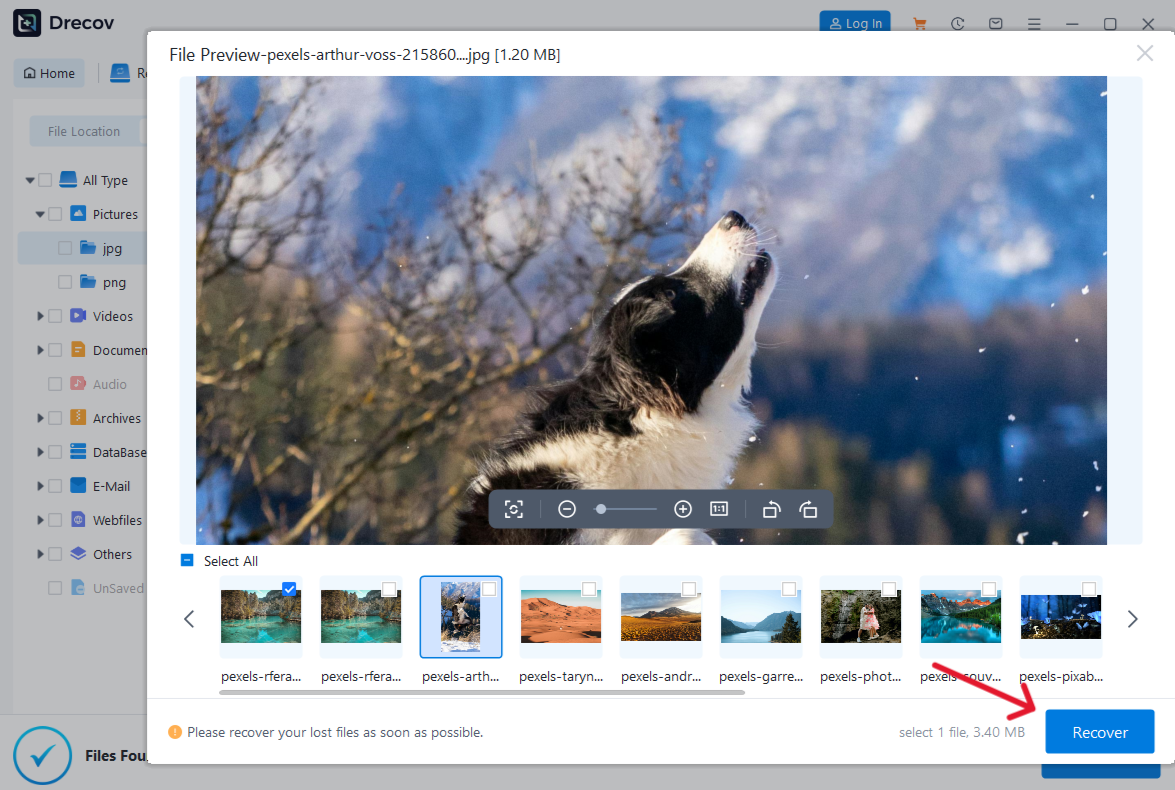
Step 4: Filter and Preview Several Audio Candidates
Filter by audio type, former path, filename, date, and size. Preview representative supported results. Listen beyond the first seconds where preview permits. A recognizable opening cannot prove that the final portion survived, so compare multiple candidates when similar versions appear.
Step 5: Recover Elsewhere and Verify the Full Track
Restore selected audio to the prepared healthy drive, never to the source. Check the Drecov Folder or Recovery Folder if the output is not where expected. Open each important result in a trusted player. Compare duration and listen at several points before converting, formatting, or repairing the original storage.
Use the Result to Choose the Final Remedy
If one trusted player handles the entire original, fix compatibility in the destination or convert a duplicate. When every decoder fails at the same point, look for another source or a more complete recovered copy. A zero-byte item needs an alternate original because there is no payload to decode.
Keep the working original, converted delivery copy, and project file separately. Add meaningful filenames and preserve capture dates. For valuable recordings, maintain two backups on different devices. A cloud sync can be one copy, but synchronization can also propagate deletion.
If the source storage showed disconnects or read errors, retire it after verified recovery. Reformatting can make a logical volume usable; it cannot renew worn flash or repair a failing controller. Test replacement media with noncritical data before trusting another recording session to it.
Conclusion
The audio file format is unsupported message does not prove the file is corrupt. Identify the real container and codec, test a trusted second player, and convert only a verified working copy. If the original recording is missing or incomplete because of local data loss, Drecov can scan its former location, preview audio candidates, and recover them to another healthy drive. Verify the entire duration before editing, converting, or changing the source storage.
⚠ Warning: Install it on a drive different from the one where your data was lost to prevent overwriting.





